Zora, a SocialFi platform closely associated with Coinbase’s Ethereum layer 2 network Base and backed by Base founder Jesse Pollak, has launched a new product called “attention markets” on Solana. The move marks a significant multichain expansion and has triggered sharp criticism from members of the Base community, many of whom accuse the project of abandoning the chain that helped fuel its recent growth.
Zora unveiled the product on February 17. The platform enables anyone to create a new market for 1 $SOL and allows users to create and trade tokenized markets tied to internet trends, memes, narratives, and cultural moments.
Early Activity and Market Data
Initial traction has remained modest. The flagship $ATTENTIONMARKETS token briefly reached a market capitalization of roughly $320,000, with about $310,000 in trading volume shortly after launch. Only a handful of other markets surpassed $10,000 in market capitalization on the first day.
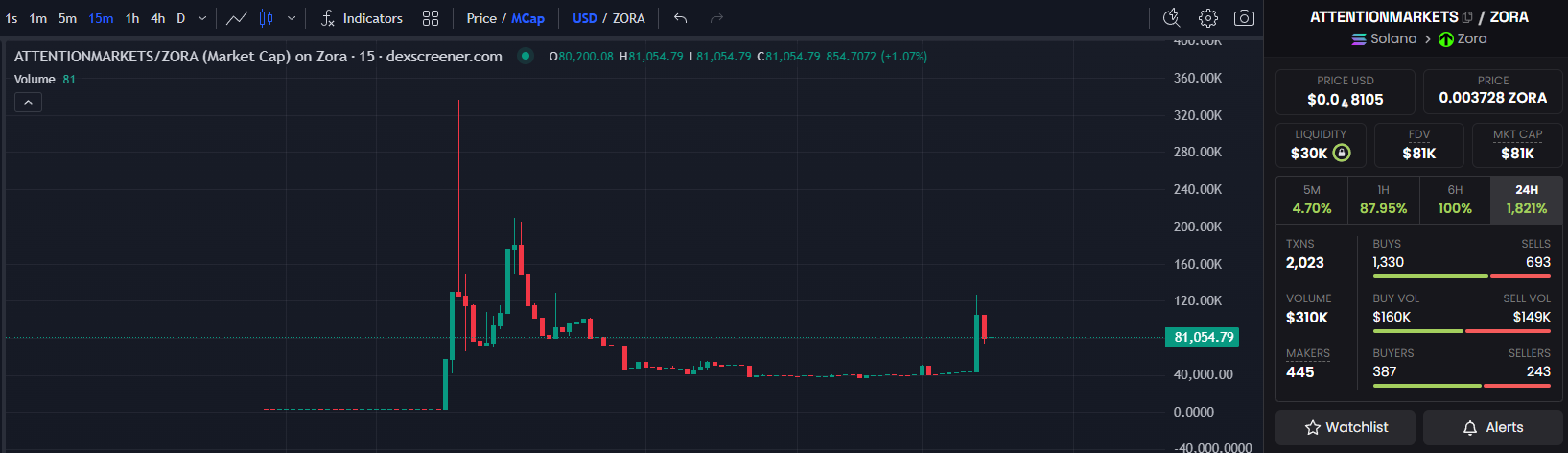
Percentage swings appeared dramatic in some cases, with one market showing gains of more than 5,500% and another rising over 300%. However, thin order books and low liquidity largely drove those moves rather than sustained demand.
The muted debut comes as other projects explore similar concepts. Polymarket recently partnered with SocialFi platform Kaito to develop its own version of “attention markets”.
Zora appears to be racing to establish an early foothold in a category that blends prediction markets with social trading.
From NFTs and Creator Coins to Attention Markets
Zora built its reputation as an onchain social and creator platform, first through NFTs and later through “creator coins.” In April 2025, the platform launched its $ZORA token on Base. In July 2025, it rolled out creator coins tied to Base profiles, which briefly helped Base overtake Solana in daily token creation.
Creator coins function as tradable representations of an individual’s online presence. A user’s profile could automatically generate a token, which supporters could buy to signal affiliation or speculate on the creator’s future popularity. If demand increased, prices rose. If interest faded, prices fell.
In January 2026, the $ZORA token also went live for trading on Solana, foreshadowing a broader multichain strategy.
Zora’s main website has since removed its previous Base-based product interface, making it unclear whether the company has fully shifted away from Base or now operates across multiple networks. Jesse Pollak said that Zora’s creator tools remain fully operational on Base, stating that they continue to run on zora.co and within the Zora app.
However, references to zora.co and the Zora app were removed from the project’s social media profiles, and the location field on Zora’s X account now lists Solana.

In a separate post that many interpreted as a response to Zora’s pivot to Solana, Pollak wrote that “Base went from not existing to one of the most important chains in the world in two years,” adding that this growth happened because of builders and that, “as with all fast growth, along the way some left, some pivoted, some gave up.” He concluded that “the builders who remain are the ones who define the next era.”
Criticism from the Base Community
The expansion to Solana has sparked a wave of backlash from Base-aligned developers, traders, and community members. Critics argue that Zora benefited from Base’s ecosystem support before pivoting to a rival chain known for memecoins and high velocity trading.
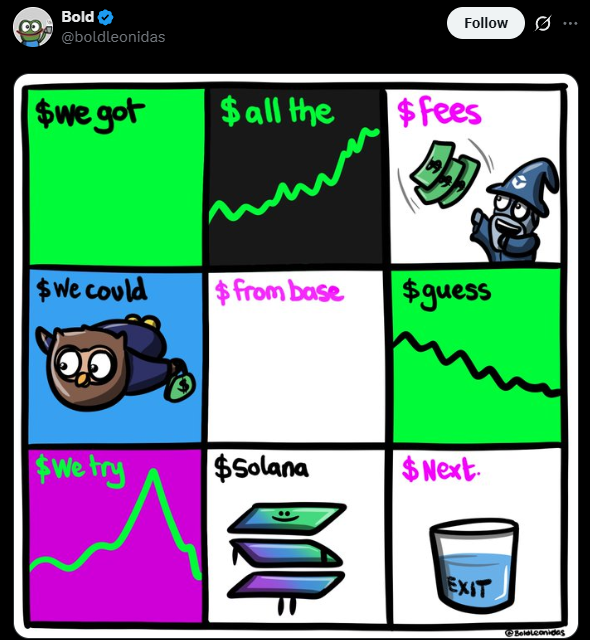
Several social media posts framed the launch as part of a pattern. One user wrote that Zora “launched its coin on Coinbase, then pivoted to Solana with an attention market to squeeze the last bit of juice out of the degens,” calling it “absolute peak of farming users across chains.”
Another commenter argued that Zora had already pivoted multiple times, first from NFTs to memecoins and now to attention markets, and described the new product as “malicious” and “low quality.”
Others criticized what they saw as a lack of transparency. One post stated that Zora did not discuss the Solana pivot with its community, echoing complaints from earlier strategic shifts. Another accused the protocol of designing products in a way that turned users into exit liquidity, claiming that revenue generated since inception would accrue primarily to founders rather than token holders.
The debate has also prompted broader analysis about competitive realities between Base and Solana. Zora previously attempted to compete with Solana’s memecoin-driven and attention-focused trading culture while operating primarily within the Base ecosystem. Solana, however, has consistently attracted liquidity, high-velocity traders, and speculative volume around social tokens and viral narratives.
From this perspective, the launch of attention markets on Solana reflects a strategic acknowledgment of where that liquidity resides. Attention-based products depend on rapid turnover, deep pools of capital, and a user base comfortable with short-term speculation. Solana currently hosts much of that activity. Several market participants argued that if a team wants to succeed in socially driven trading, it must build where traders and liquidity already operate. In that reading, the move does not simply signal a pivot away from Base, but an attempt to align product design with the network that has proven most effective at capturing attention-centered speculation.
Read More on SolanaFloor
Solana Validator Economics Abused by Universities and DATs Running “Malicious” Mod
Notorious Actor Hayden Davis Returns to the Memecoin Trenches, Losing $3 Million
Can Digital Asset Treasuries Survive the Crash?