
Solana co-founder Anatoly Yakovenko recently shared details of a new experimental project running on Solana devnet called Percolator / SOV. The project combines memecoin trading with a novel form of perpetual futures trading, in which the same token serves as both the traded asset and the collateral backing the market. Yakovenko framed the work as an open-ended experiment rather than a production system, emphasizing software design, risk containment, and onchain transparency.
While the project drew interest, Yakovenko consistently cautioned that the system remains a devnet prototype and carries meaningful risk.
SOV’s Inverted Perpetual Market Design
Yakovenko described SOV as an inverted market structure. In this design, a memecoin backs trading directly, rather than relying on external collateral such as $SOL or stablecoins.
Fees generated by trading flow into a permanent insurance fund. That fund does not recycle tokens back into circulation. Instead, it locks them indefinitely, creating what Yakovenko described as a "soft burn," which steadily reduces circulating supply over time.
This structure intentionally limits systemic risk. If the market fails, losses remain confined to the memecoin used within the system. Yakovenko acknowledged that the Solana program remains upgradable during testing, which introduces the possibility of misuse. However, he stressed that the only asset at risk in the market is the memecoin itself, not external collateral.
Percolator as a Risk Engine & Open Source Development
Percolator serves as the underlying risk engine powering the experiment. Yakovenko built it as an open-source, onchain perpetual futures framework designed for Solana decentralized exchanges. The current devnet version handles accounting, margin tracking, and liquidations through oracle price feeds.
Several developers have already forked Percolator, often with Yakovenko providing direct feedback and technical guidance. He repeatedly emphasized that he values bug-free, formally verified, immutable software over fee extraction or short-term revenue. In his view, modern onchain systems have no justification for closed source code, opaque upgrade keys, or unverified builds.
In one implementation, traders access leveraged perpetual trading for the $PERC/USD pair. The platform charges a 0.3 percent fee on trades, with all fees routed into the permanent insurance fund. Developers report more than 22 million $PERC in cumulative open interest since launch, although the system remains explicitly experimental.
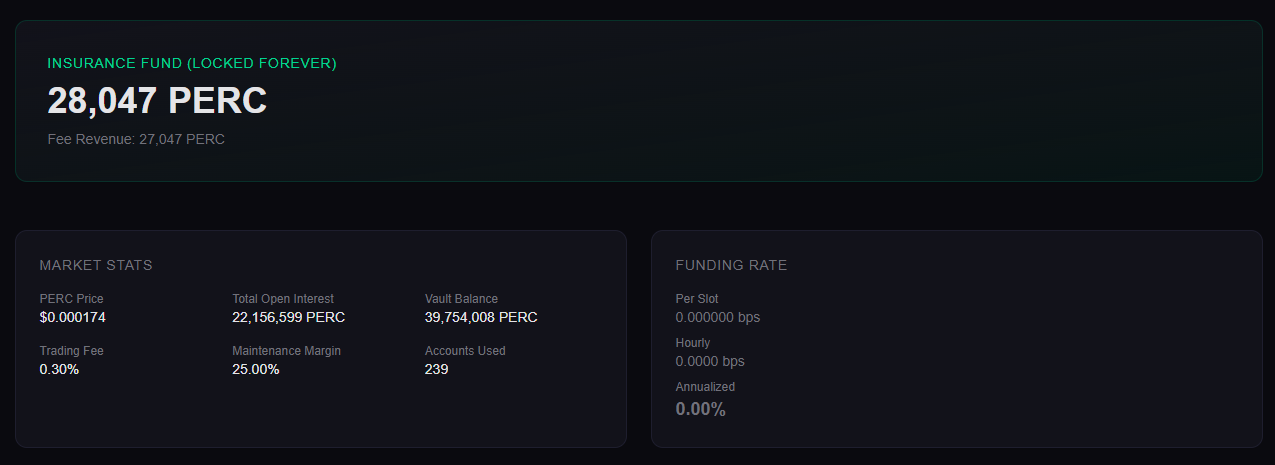
Other ecosystem participants also engaged with the experiment. DFlow founder Nitesh Nath publicly asked which forks planned to integrate routing through DFlow, signaling early interest from infrastructure providers.
Meanwhile, the developer behind the above-mentioned implementation stated plans to revoke program upgradability after sufficient testing, which would reduce the risk of future changes while preserving the inverted perpetual design.
Yakovenko responded publicly to questions about oracle sources, upgradeability, and attack surfaces. He argued that aggressive scrutiny of forks plays a useful role. He suggested that repeated stress, criticism, and failed forks help filter out weak designs, leaving only stronger implementations.
A Long-Running Research Effort
The Percolator project first surfaced publicly last October, when Toly’s GitHub activity revealed work on a sharded perpetual exchange protocol for Solana. Documentation described a self-custodial, onchain perps DEX with sharded matching engines, referred to as slabs, that operate in parallel. A router program coordinates margin, positions, and atomic execution across those slabs.
Yakovenko later clarified that he uses the project to test ideas, including whether a prop-style automated market maker competition could work for perpetual futures.
At the time, core components such as the router, memory pools, and order book structures appeared largely complete, while other elements, including parts of the liquidation engine, remained under development. Multiple external contributors submitted pull requests, indicating early collaborative interest.
Throughout discussions around Percolator / SOV, Toly returned to a consistent theme. He argued that each market cycle demands a renewed focus on self-custody, trust minimization, and verifiable onchain systems. In that context, the memecoin experiment functions less as a product launch and more as a live test of how far those principles can extend into high-risk trading infrastructure.
The $PERC Memecoin
Solana traders were quick to act as Percolator gained renewed traction, sending the $PERC memecoin sharply higher. The token launched in October, around the time Yakovenko’s Percolator work first surfaced publicly on GitHub. It initially climbed to a market capitalization of roughly $6 million before interest faded and the price fell below $100,000.
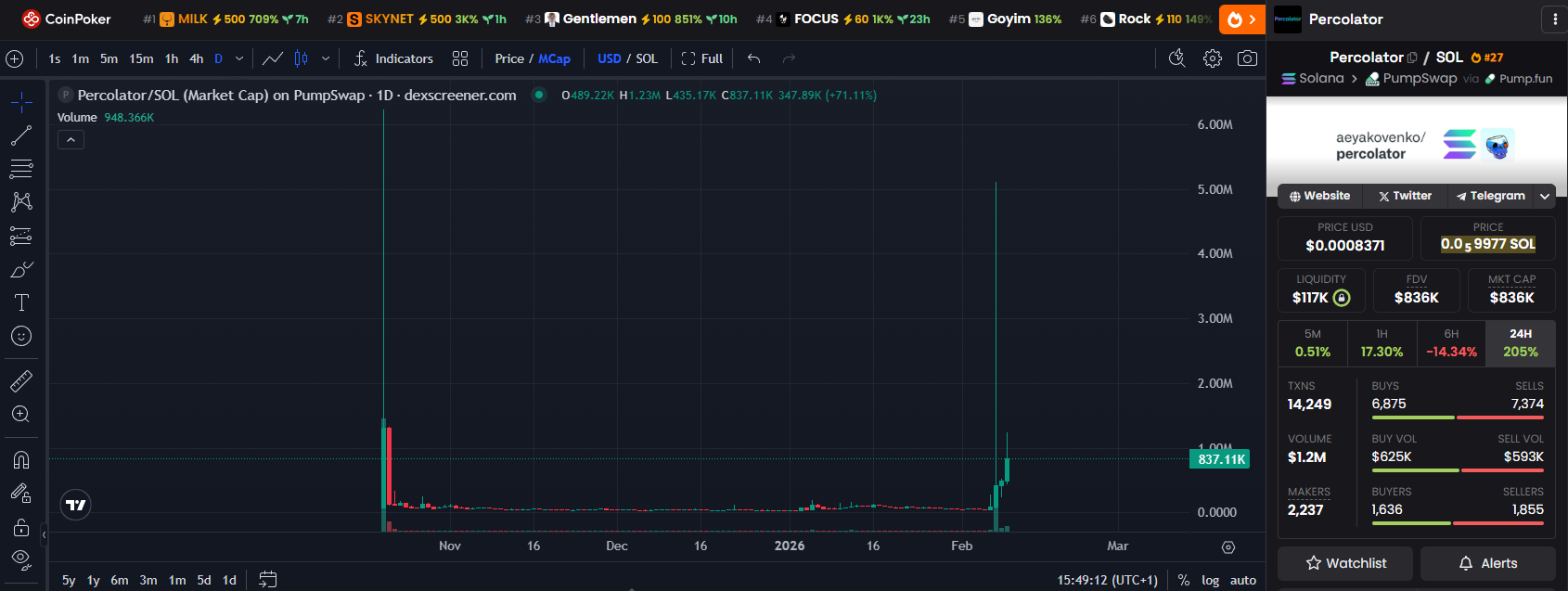
When Yakovenko recently shared details of SOV and the inverted perpetual market design, speculative activity returned. $PERC surged again, reaching a market capitalization of about $5 million before retracing. At the time of writing, the token trades at around an $800,000 market cap.
Read More on SolanaFloor
Is the Crypto Crash Over, Or Will the Unwind of DATs be the Final Capitulation Event?
$2.6 Billion Liquidated as Bitcoin Falls Below $60K & Solana Hits $68 - Global Markets Enter Risk-Off Mode
Are You Participating in Solana Seeker Season 2?