$RNGR Buyback Proposal Sparks Debate on Ownership Coins
Ranger investors propose using treasury funds to buy $2M worth of $RNGR
- Published:
- Edited:
Ownership coins and futarchy are facing some rare cycnism this week, with a new community-led proposal, RNGR-001, reigniting the age-old concerns surrounding crypto governance.
Futarchy can theoretically provide more value-aligned, market-driven outcomes than the token-weighted governance models of yesteryear. However, critics argue that just because investors can guide protocol governance doesn’t mean they should.
Despite the flaws of community governance, certain Solana DeFi applications are embracing the shift to “ownership coins”.
$RNGR Holders Seek “Exit Liquidity”?
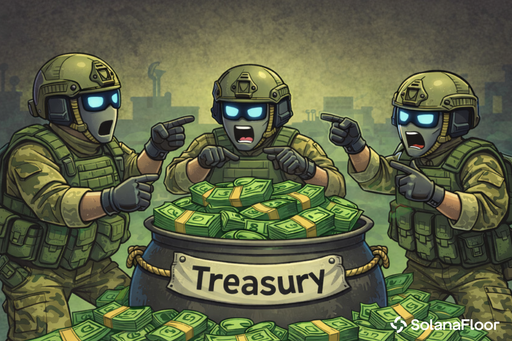
Within three days of $RNGR concluding its MetaDAO ICO, community members are already trying to make use of the protocol’s treasury. In the wake of a disappointing token launch, which sees $RNGR trade at an 18.75% to its ICO price, token holders have floated a proposal suggesting that $2M be expensed from the Ranger treasury to fund buybacks.
Community members responsible for the proposal argue that this use of capital will “improve overall sentiment” and “protect our holders”. At press time, it’s still too early to say whether or not the proposal is expected to pass. MetaDAO’s UI has scored the likelihood of the proposal passing at 50%, and the market has yet to witness substantial volume.

Meanwhile, members of the Ranger community have decried the proposal, arguing that allocating $2M to $RNGR buybacks does nothing but provide “exit liquidity” for investors who are disappointed by the first week’s trading of an emerging startup.

Remarking that the proposal is “short term focused”, Ranger Finance cofounders FA2 and Barrett have indicated that they will not be trading the proposal, instead leaving futarchic decision markets to run their course.
Is Governance a Failed Experiment?
In the eyes of many Solana community members, the RNGR-001 proposal highlights some of the biggest flaws of decentralized governance. While giving power back to the journeyman investor is one of crypto’s core cultural tenets, one could argue that passing influence to hordes of short-term investors is hardly in the best interests of an emerging business.
The role and importance of governance tokens have been called into question in recent weeks, with several crypto assets finding themselves completely worthless following large-scale acquisitions. Tokens like Tensor’s $TNSR were recently left for dead after the firm’s acquisition by Coinbase, highlighting the flaws of the oft-maligned token + equity legal structure.
Pioneered by MetaDAO, futarchic ownership coins are often considered an elegant solution to token/equity split. However, as evidenced by the criticism of RNGR-001, ownership coins are not without problems of their own. In a recent article, MetaDAO co-founder Proph3t admits that there was “some truth to these criticisms.”

Musing on the state of onchain capital formation, Proph3t reiterated that maintaining the trust of investors is a “continuous process”.
Established Solana DeFi Apps Pivot to Futarchy
Despite the imperfections, Solana apps are embracing the shift towards ownership coins. Flash Trade, a perps exchange, recently announced that it would be adopting MetaDAO’s futarchic governance structure.
Meanwhile, Solana’s OG governance platform, Realms, has announced the launch of its own onchain fundraising primitive, giving network participants more ways to join onchain capital formation endeavors.
Read More on SolanaFloor
What can we expect from the CLARITY ACT?
Why is Passing the CLARITY Act So Critical to Solana’s Growth?
SolanaFloor Sits Down with MetaDAO’s Proph3t