Over 81% of Whale Voting Weight Backs Zero Emissions in Jupiter DAO Vote
Onchain data reveals a widening divide between whale and retail voters as governance tensions emerge
- Published:
- Edited:
The ongoing governance vote within the Jupiter DAO has quickly become one of the most closely watched tokenomics decisions on Solana in February 2026. Started on February 17, the proposal asks the community to choose between two fundamentally different approaches to managing $JUP’s future supply: proceeding with the planned 700m $JUP airdrop, known as Jupuary, or adopting a Zero Net-New Emissions model that pauses new emissions and introduces treasury-funded buybacks.
While the vote remains ongoing, early onchain data offers insight into how different classes of stakeholders are positioning themselves and what the outcome could signal for decentralized governance more broadly.
Airdrop Leads in Votes, But Loses in Voting Weight
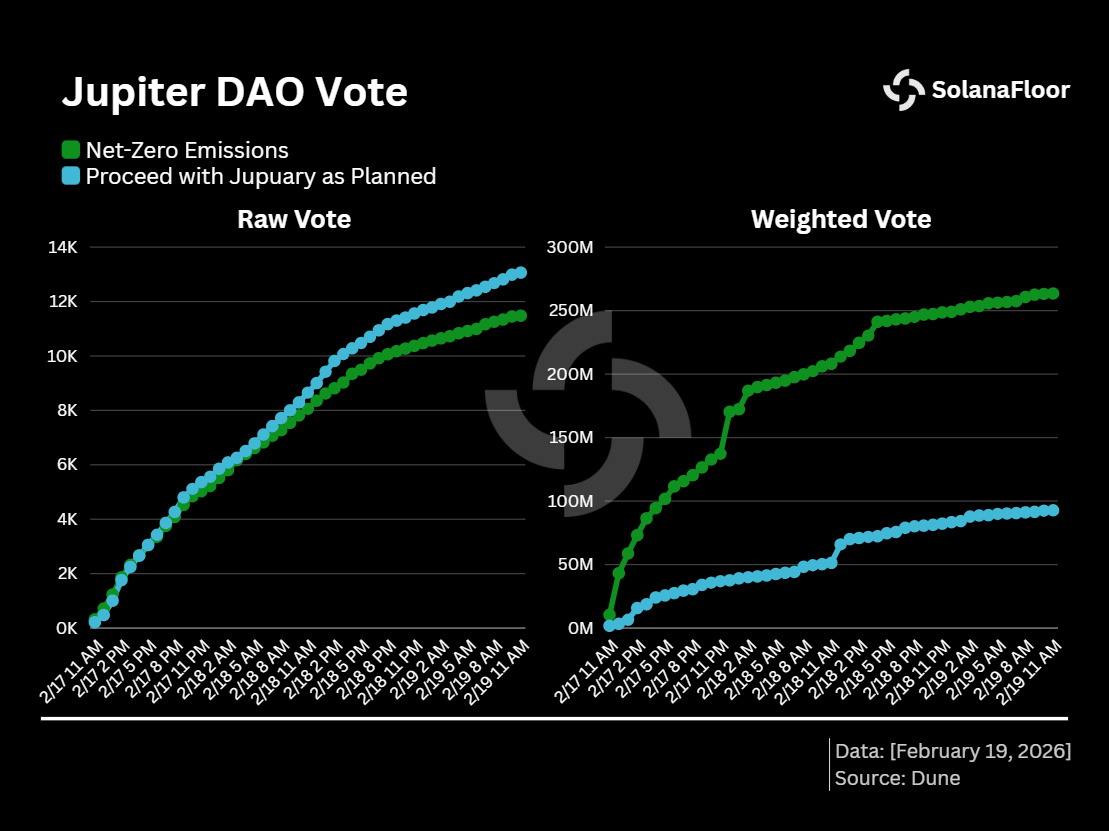 Within the first 48 hours, more than 24.5k votes were recorded onchain. By raw vote count, the "Proceed with Jupuary" option is leading, with over 13k individual voters supporting the continuation of the planned airdrop. This suggests broad participation and strong engagement among smaller holders.
However, DAO governance is determined not by the number of wallets, but by the amount of staked tokens backing each vote. When measured by voting weight, the results shift dramatically. The "Zero Net-New Emissions" proposal controls more than 73.9% of total voting weight, giving it a commanding lead.
Whales Strongly Back Emissions Halt
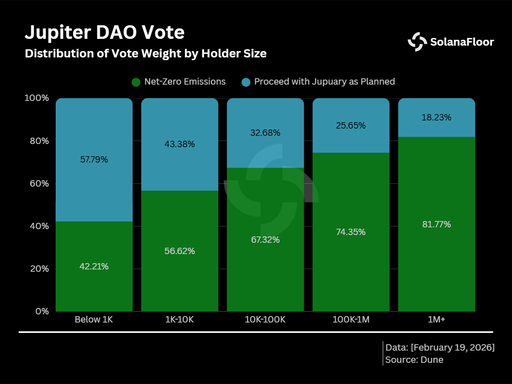
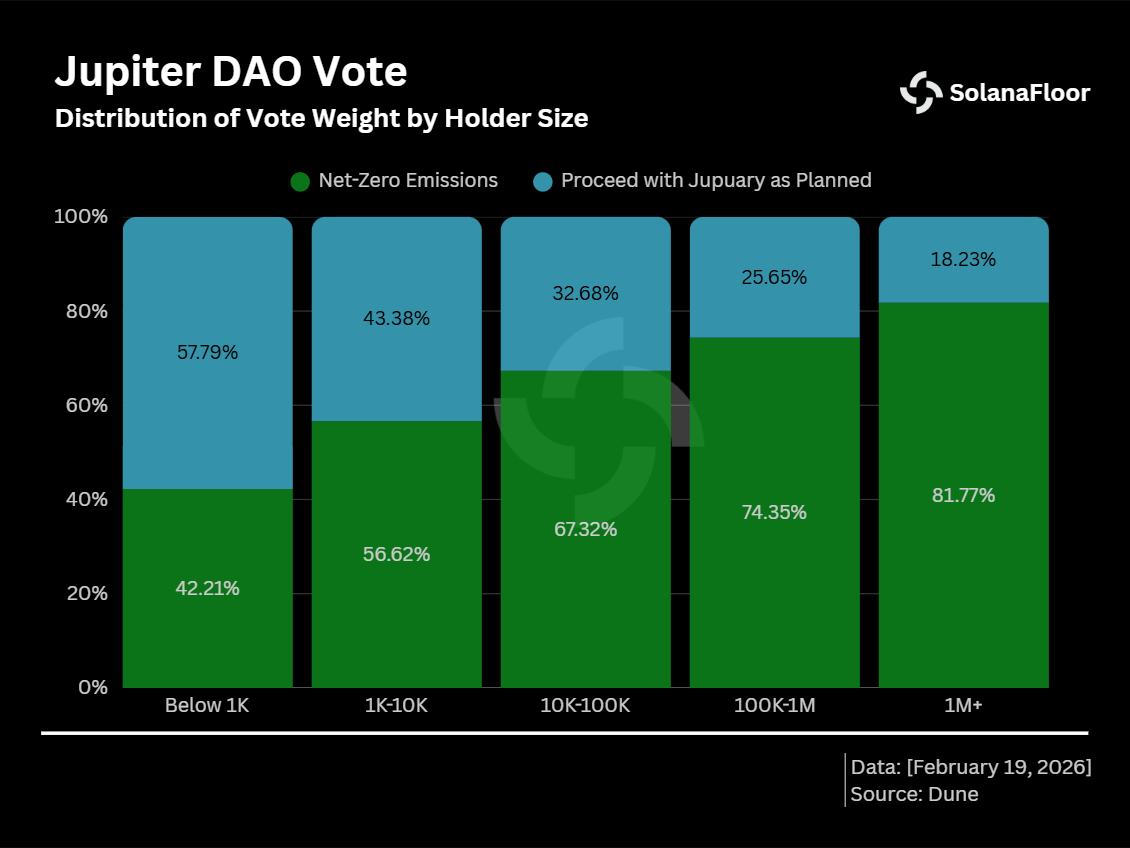 A closer examination of onchain voting distribution reveals a clear pattern among large token holders. Wallets staking more than 1m $JUP allocated over 81.7% of their combined voting weight to the Zero Net-New Emissions option.
This trend becomes more pronounced as stake size increases. Higher-weight voters consistently show stronger support for halting emissions and implementing buybacks, while smaller wallets tend to favor continuing the planned airdrop. Wallets with vote weight less than 1k $JUP are disproportionately represented among supporters of Jupuary.
From a tokenomics perspective, the Zero Net-New Emissions proposal attempts to neutralize net supply growth. The framework involves postponing the airdrop, halting team emissions, and using protocol treasury funds to conduct buybacks. Jupiter’s core aggregator product generates trading fees independent of token emissions, providing a potential funding source for such buybacks without increasing circulating supply.
Mercurial Vesting Returns to Focus
Part of the current governance discussion stems from legacy allocations tied to Mercurial Finance, the stablecoin protocol from which Jupiter originated. During the transition to Jupiter, 5% of the total $JUP supply, or 350m tokens, was allocated to Mercurial stakeholders.
These tokens follow a structured vesting schedule, with gradual unlocks over a 24-month period. As of February 2026, approximately 182m $JUP, or 52% of the allocation, has already vested. The remaining 168m tokens continue to unlock over time.
Under the Zero Net-New Emissions proposal, remaining vesting allocations would be accelerated and offset by treasury buybacks. This mechanism is designed to prevent net increases in circulating supply, addressing concerns that ongoing unlocks could contribute to sustained sell pressure.
Concentrated Voting Power and Community Concerns
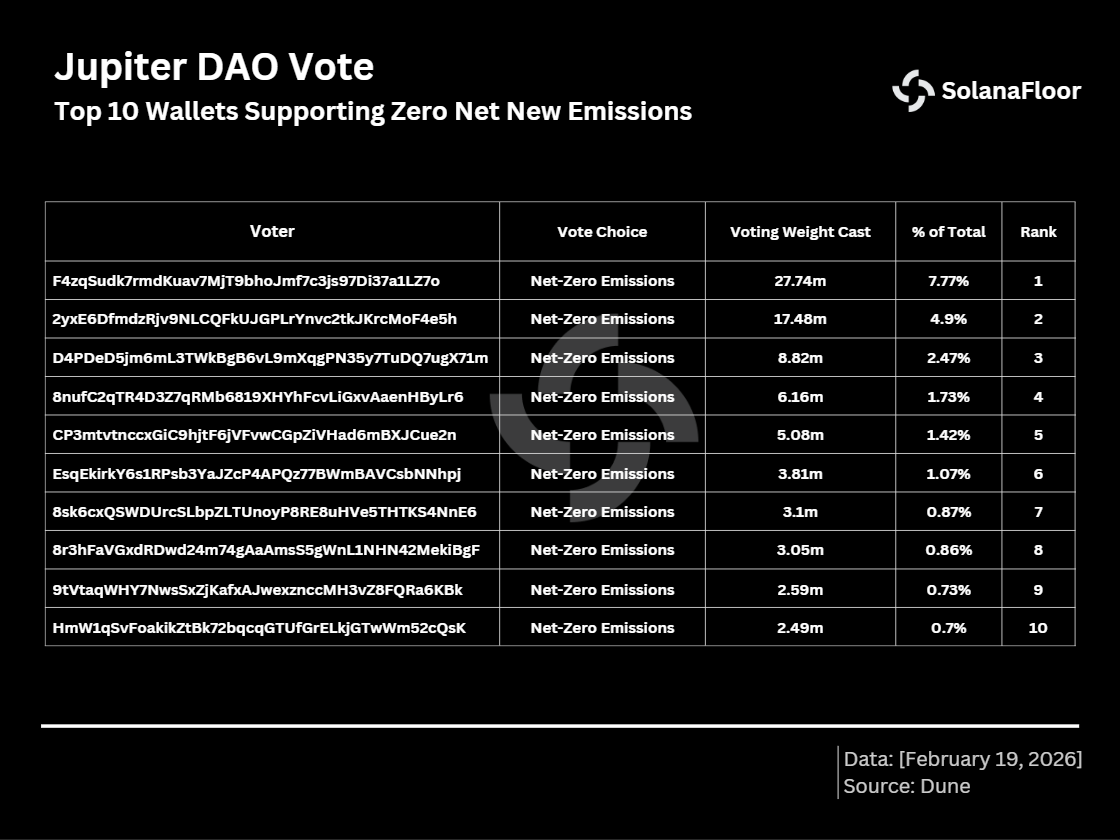 Data also shows that voting influence is highly concentrated. The ten largest voting wallets supporting the Zero Net-New Emissions option collectively account for more than 22.5% of total voting weight.
One wallet in particular, holding over 27.7m staked $JUP, represents the single largest voting wallet in the proposal. Community members have speculated about potential affiliations between large voting wallets and team members or early insiders.
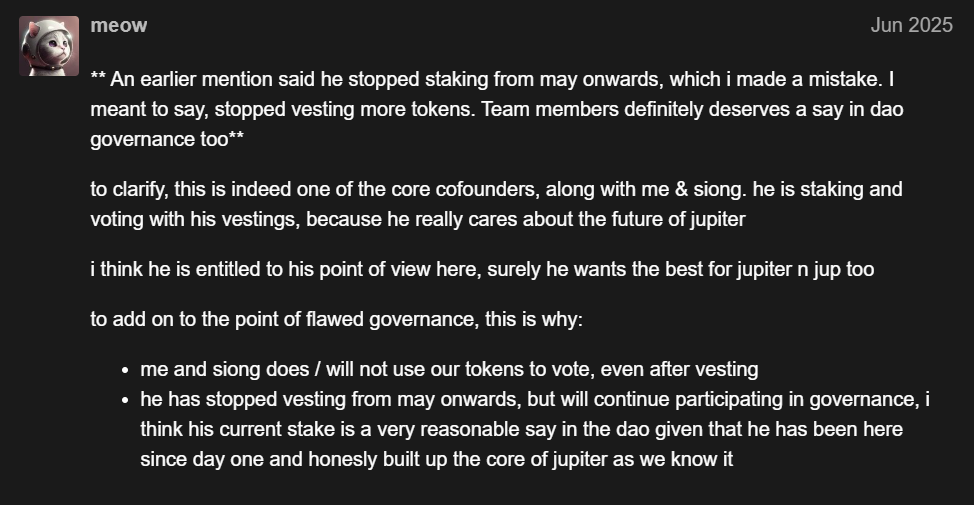 Meow, Jupiter’s cofounder, has stated in community discussions in June 2025, that this wallet (F4zq...LZ7o) is associated with one of the core cofounders and that the votes originate from vested token allocations.
The situation has triggered broader discussions around governance fairness. Some participants have expressed concern that token-weighted systems may allow concentrated capital to exert disproportionate influence over outcomes, even when raw voter participation points in another direction.
At the same time, token-weighted governance is designed to align decision-making power with economic exposure. Large holders bear greater financial risk and therefore have stronger incentives to support policies that preserve long-term value.
Governance, Influence, and the Question of Manipulation
The vote underscores a structural divide between participation and economic influence. Although more than 24.5k wallets have cast ballots and over 13k support the airdrop, 73.9% of total voting weight and 81.7% of whale-controlled weight favor emissions reduction. Particular attention has focused on the F4zq...LZ7o wallet, which holds over 27.7m staked $JUP and represents the largest single voting wallet in the proposal. Meow, Jupiter’s cofounder, has stated that the address is associated with a core cofounder and reflects vested token allocations. With the top ten wallets accounting for more than 22.5% of total voting weight, concerns about concentrated influence have intensified. Nevertheless, even collectively these wallets constitute only a portion of overall voting power, and the outcome remains a function of token-weighted governance rather than the dominance of any single address.
This piece is part of our Solana Data Insights series. Make sure to subscribe to Solana Data Insights for weekly onchain analysis.
Read More on SolanaFloor
Solana Commands 49% of x402 Market Share as the Race for Micropayment Dominance Intensifies
Inflation Is Broken: The Truth Behind Crypto’s Next Move | Stefan Rust