
Jupiter Weighs Plan to Drive $JUP Token Emissions to Net Zero for the Rest of 2026
DAO vote could reshape Jupuary airdrop, vesting schedules, and token supply dynamics.
- Published:
- Edited:
Jupiter, one of Solana’s most prominent DeFi platforms, has introduced a governance proposal that would significantly alter the emission trajectory of its native token, $JUP. The proposal, titled “Going Green,” asks the Jupiter DAO to consider restructuring three primary sources of projected 2026 token emissions. If token holders approve the measure, Jupiter would move to net-zero token emissions for the remainder of the year.
The proposal arrives at a sensitive moment for the project. In recent weeks, $JUP has fallen to new all-time lows near $0.136, prompting vocal debate across social channels about tokenomics, communication, and the delayed annual airdrop known as Jupuary.
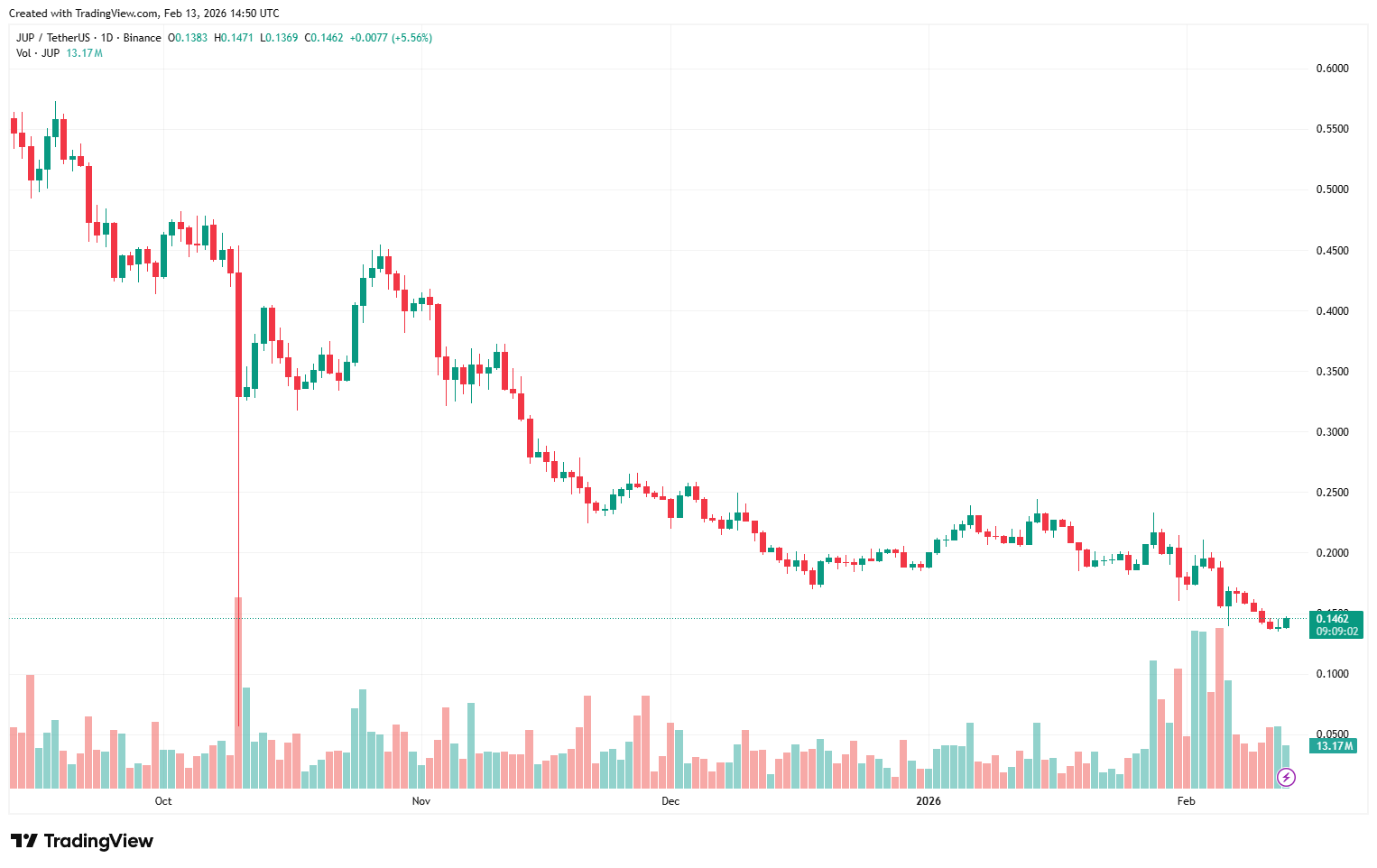
Against that backdrop, the DAO must now decide whether to proceed with existing distribution plans or adopt a more restrictive supply approach.
Background: Emissions and Prior Supply Actions
Jupiter has already taken several steps aimed at tightening supply. The protocol has burned 3 billion $JUP tokens to date, including 30% of the team’s strategic reserve. Founders have locked their tokens, with co-founder Meow committing to a lockup that extends until 2030. The protocol also allocates 50 percent of onchain revenue to open market buybacks. In 2025 alone, Jupiter directed more than $70 million toward buybacks.
In October 2025, Jupiter’s leadership introduced a program titled “A Fresh Start for $JUP.” The initiative narrowed the DAO’s focus to major tokenomics and treasury decisions, reduced the unstaking window from 30 days to 7 days, and eliminated roughly 4% of the circulating supply through a token burn known as “Burn the Litterbox.”
Institutional developments have also shaped the token’s trajectory. Last year, 21shares launched the 21shares Jupiter ETP in Europe under the ticker AJUP, offering regulated exposure to $JUP.
On February 2 at Catlumpurr, Jupiter announced a $35 million strategic investment into $JUP from ParaFi Capital at market price, accompanied by an extended token lockup.
The Three Sources of Emissions
The current proposal centers on three major sources of projected emissions in 2026.
First, Jupuary serves as Jupiter’s annual airdrop. The event typically distributes a large allocation of tokens to active users and stakers. Although the DAO originally approved 700 million $JUP for the 2026 airdrop, Jupiter announced in November that only 200 million tokens would come from that allocation. Even so, the airdrop represents a significant increase in circulating supply.
Second, team vesting releases tokens to contributors over time. Jupiter designed this structure to align incentives and reward team members for building the ecosystem. However, critics have argued that ongoing unlocks contribute to dilution and market pressure.
Third, Mercurial stakeholder vesting accounts for 5% of the total supply. Jupiter spun out of the Mercurial project, and the protocol allocated this portion of tokens to Mercurial holders and investors.
Together, these streams have driven much of the recent community discourse around inflation and dilution.
Fork In the Road: The Two Voting Options
Token holders will vote between two distinct paths.
Under Option 1, Jupiter will continue as planned. Jupuary would proceed, team vesting would continue on schedule, and Mercurial vesting would remain unchanged. If the DAO selects this route, Jupiter expects to launch the airdrop checker approximately one week after the vote concludes, with distribution following a few weeks later.
Under Option 2, Jupiter would postpone Jupuary, pause team emissions, and buy out Mercurial investors.
Postponing Jupuary would remove approximately 700 million tokens from near-term circulation and return them to the DAO treasury. Pausing team vesting would prevent additional scheduled unlocks from entering circulation. To address Mercurial stakeholder emissions, Jupiter would conduct an immediate airdrop to those holders. For every token that Mercurial stakeholders sell on the open market, Jupiter would commit to purchasing an equivalent amount using balance sheet capital, directly absorbing sell pressure.
Importantly, Active Staking Rewards would remain unchanged at 2025 levels regardless of the vote outcome. Stakers would remain eligible for ASR regardless of whether they participate in the governance process.
Community Context and Market Sentiment
The proposal follows weeks of public frustration. Some holders have criticized the delay of Jupuary and questioned the team’s communication strategy. Others have attributed $JUP’s decline to broader weakness in the Solana ecosystem, noting that tokens such as $JITO, $RAY, $PYTH, and $PUMP have also experienced significant drawdowns.
Commentary across social platforms reveals a divided community. Some participants argue that Jupiter continues to build aggressively and attract institutional interest, while others focus on dilution, narrative shifts, and what they view as inconsistent messaging around token expectations. Large unlocks and visible sell pressure have intensified scrutiny of vesting schedules.
Timeline and Next Steps
The governance timeline sets February 13 as the start of the public comment period with a town hall session on X slated for February 16. The DAO vote opens on February 17 at 11 AM UTC and closes on February 21 at 11 AM UTC. Jupiter will execute the outcome entirely according to the DAO’s decision.
Jupiter has framed the proposal as part of a broader commitment to treat $JUP as a product that evolves through experience and user feedback rather than fixed theoretical assumptions. The upcoming vote will determine whether the DAO prioritizes distribution continuity or supply restraint for the remainder of 2026.
The result will likely shape both short-term market dynamics and longer-term perceptions of how Jupiter balances growth incentives with token supply discipline.
Read More on SolanaFloor
Can You Protect Yourself Against Hacks? - Key Takeaways from Certora’s Livestream on Evolving Threats and What Protocols Must Do Next
Developers on Solana Increase Almost 10X Since 2020 as Network Welcomes a Record 3830 New Devs in 2025
Can Digital Asset Treasuries Survive the Crash?