
If you have some $SOL staked natively, you’re probably earning about 6% APY of yield but not much else. Jupiter Exchange has introduced a feature where you can use native staking as collateral on Jupiter Lend, allowing users to borrow against natively staked $SOL without relying on liquid staking tokens. The update gives stakers direct access to DeFi while their assets continue to earn staking rewards.
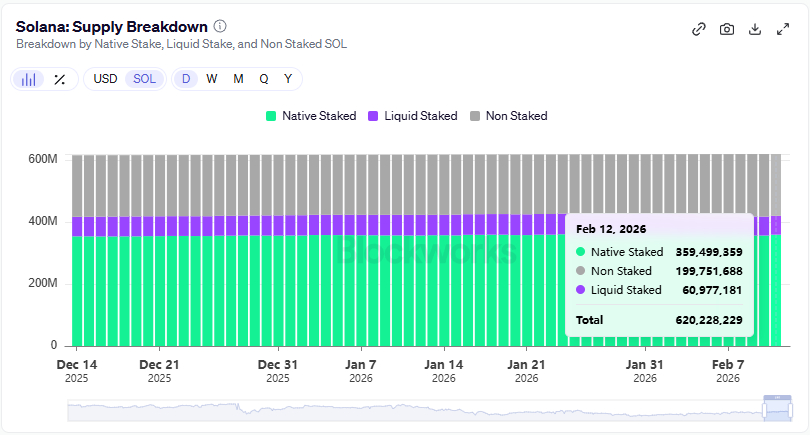
According to Blockworks data, $30.5 billion worth of $SOL currently sits in native staking positions. This capital earns yield but has historically remained locked out of DeFi markets unless users convert their positions into liquid staking tokens. Solana’s native staking imposes a 2-7 day cooldown on unstaking, which limits flexibility for active DeFi participants. Marinade Finance sought to address this friction by launching Instant Unstake in collaboration with Anza, allowing users to exit native staking immediately without wrapping or waiting.
Jupiter Lend now enables users to keep their $SOL staked with supported validators while borrowing against that position directly.
How Native Staking as Collateral Works
The process follows a straightforward structure. First, a user stakes $SOL with one of the supported validators. Jupiter Lend then automatically detects the staking position and represents it as an nsVALIDATOR. Users can borrow $SOL against this detected position without moving their stake into a separate liquid staking protocol.
Staking rewards continue to compound in the background while the borrowed funds remain in use. The entire system operates fully onchain and remains non-custodial. Users maintain control over their underlying stake, and the protocol does not require any liquid staking tokens to facilitate borrowing.
On Jupiter Lend, users can borrow up to 87 percent of their staked position’s value. The liquidation threshold sits at 88 percent. Each validator operates its own vault, though the borrowing flow remains identical across all of them.
At launch, Jupiter supports six validators. These include Jupiter, represented as nsJUPITER, Helius as nsHELIUS, Nansen as nsNANSEN, Blueshift as nsSHIFT, Kiln as nsKILN, and Temporal as nsTEMPORAL. Each vault corresponds directly to its validator, allowing users to borrow against their specific staking position.
Jupiter has indicated that it plans to expand support to additional validators over time in order to cover a broader portion of the Solana ecosystem.
Solana’s Expanding Staking Landscape
The launch arrives at a time when Solana staking metrics continue to trend upward. On January 20, Solana’s staking ratio reached a new all-time high of 70%.
The network is currently secured by more than $35 billion worth of staked $SOL. Data from Blockworks shows that more than 420.4 million $SOL remain staked on the network.
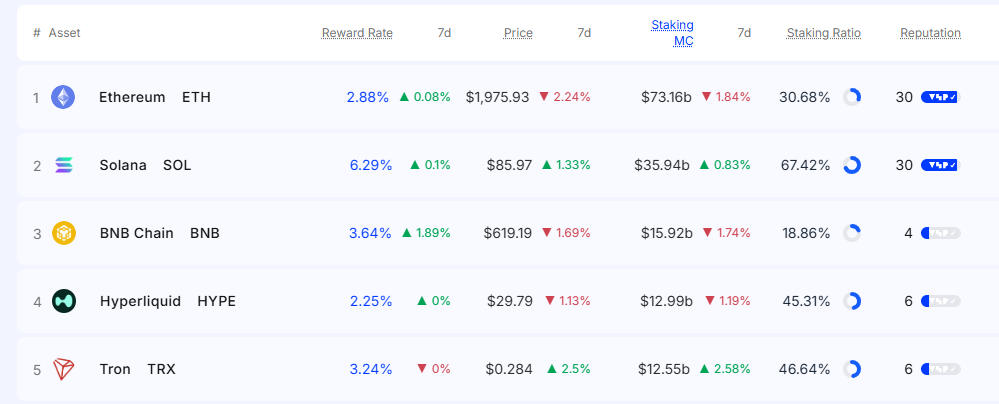
Among the top five proof-of-stake blockchains, Solana leads with a staking rate of 67.42 percent. Validator participation also remains robust.
Jupiter’s new feature adds another layer to this evolving landscape. Instead of routing through liquid staking tokens, users can now access liquidity directly from native staking positions. This design may influence how capital flows between native staking, liquid staking, and lending markets.
Broader Context Within Jupiter’s Ecosystem
The staking collateral launch comes as Jupiter’s DAO evaluates a proposal titled Going Green to restructure projected token emissions and potentially move toward net zero emissions for the remainder of the year. The vote will determine whether to continue planned distributions, including Jupuary, team vesting, and Mercurial allocations, or to postpone the airdrop, pause vesting, and buy out Mercurial stakeholders using balance sheet capital.
Active Staking Rewards will remain unchanged at 2025 levels. The governance process runs from February 17 to February 21, 2026, following a public comment period and town hall. Although separate from the staking collateral feature, the proposal reflects Jupiter’s broader effort to refine its product and token structure through onchain governance.
A Structural Shift for Solana DeFi
The introduction of native staking as collateral carries significant implications for Solana DeFi. The feature improves capital efficiency by allowing stakers to retain yield while accessing liquidity through borrowing. It also reduces reliance on liquid staking tokens for lending, offering a direct alternative that removes the need for token wrapping in certain use cases. By unlocking more than $30 billion in previously dormant staked capital, the model could contribute to meaningful growth in total value locked across Solana lending markets.
At the same time, the expansion strengthens Jupiter’s position within the ecosystem by extending its role beyond aggregation into staking backed lending infrastructure. This shift may heighten competition among lending protocols such as MarginFi and Kamino, which could face pressure to adopt similar integrations to maintain market share.
If adoption grows, the feature could reshape lending dynamics, validator participation incentives, and liquidity distribution across Solana DeFi.
Read More on SolanaFloor
Solana Commands 49% of x402 Market Share as the Race for Micropayment Dominance Intensifies
deBridge Brings ‘Vibe Trading’ to the Onchain Economy as Solana Seeks to Reclaim x402 Lead
Can Digital Asset Treasuries Survive the Crash?