
Global financial markets entered a pronounced risk-off phase as investors reassessed exposure across cryptocurrencies, precious metals, and U.S. equities.
Over the past month, persistent volatility, forced deleveraging, and macroeconomic uncertainty reshaped market behavior and pushed several asset classes sharply lower.
Crypto Market Faces Heavy Selling Pressure
The cryptocurrency market experienced a significant drawdown over the last 30 days, with the total crypto market capitalization falling 29.5% from $3.18 trillion to $2.24 trillion. Bitcoin dropped below its 2021 all-time high and briefly fell below $60,000 before rebounding. At the time of writing, it is currently trading around $65,643. This decline marked a notable shift in sentiment for an asset that many investors once viewed as digital gold.
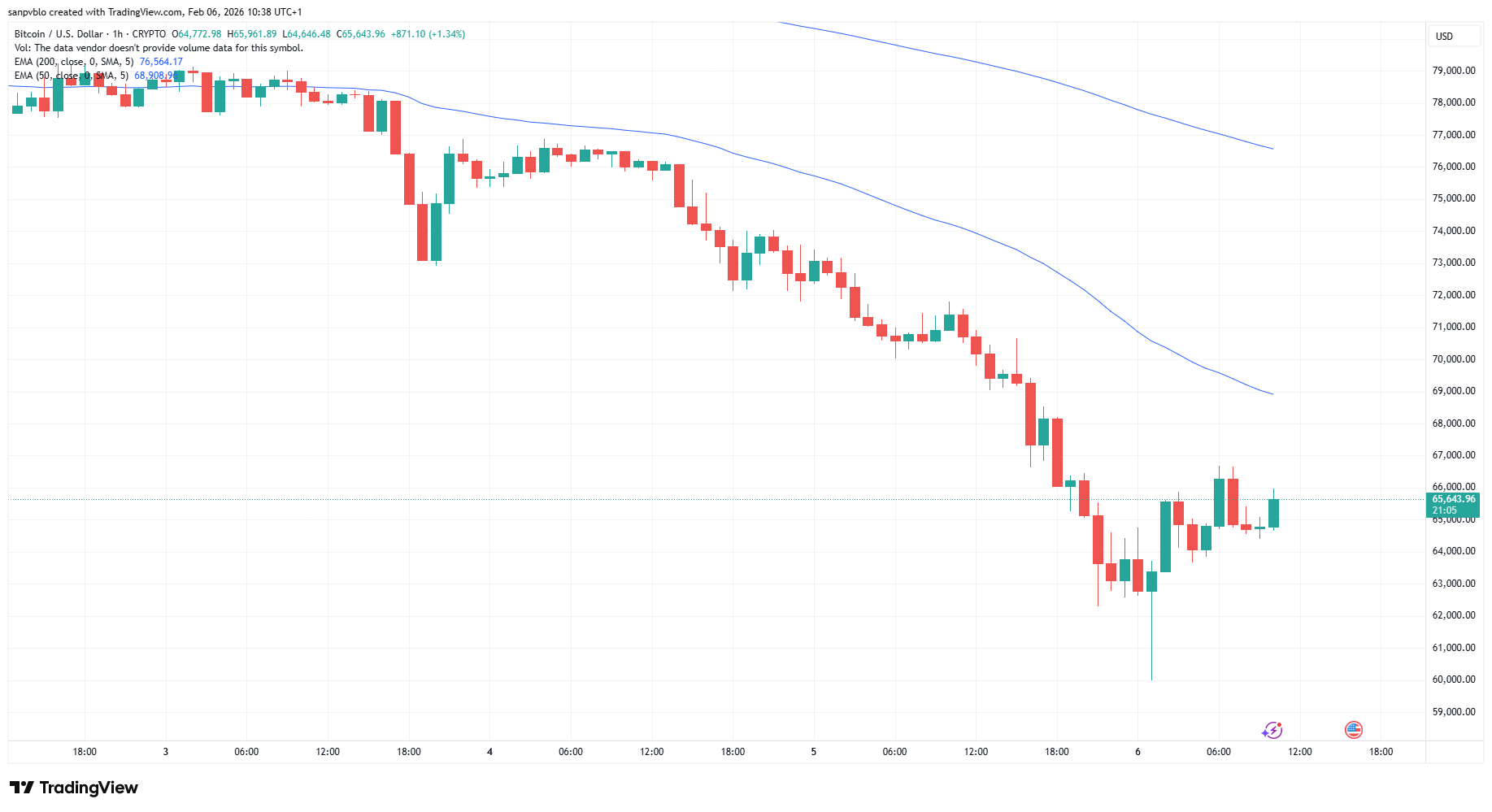
Selling accelerated as bitcoin broke below the $70,000 level, triggering further downside momentum. Over the past week alone, bitcoin fell roughly 20%, reaching its lowest level since October 2024. In the last 24 hours, more than $2.6 billion in crypto positions were liquidated, impacting over 580,000 traders. These liquidations reflected aggressive forced deleveraging in futures markets as leveraged positions unwound.
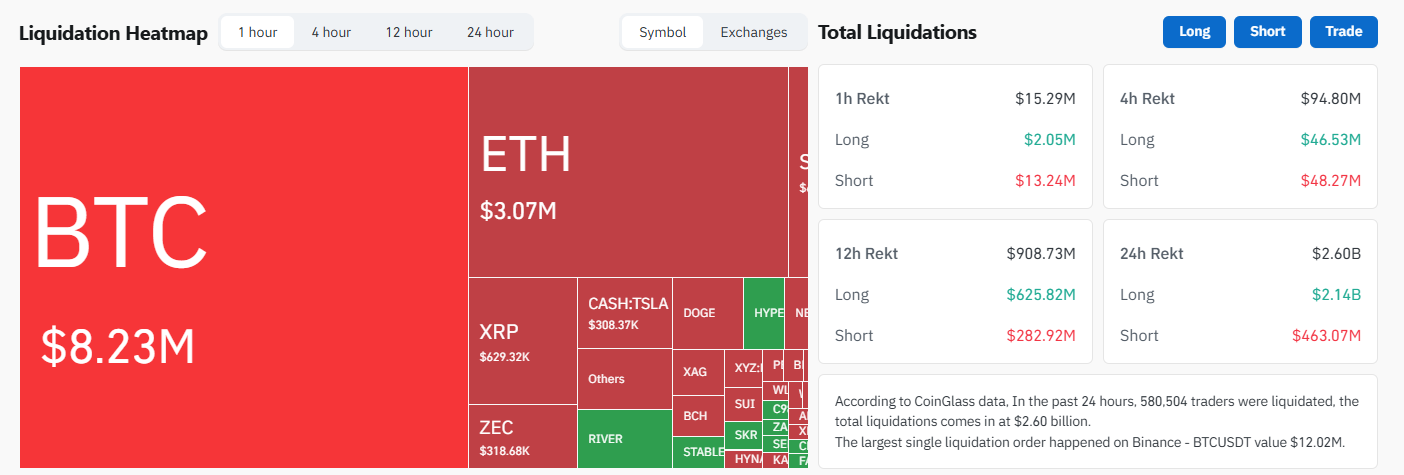
Other major cryptocurrencies followed the same trajectory. Ether declined 33% during the week, its steepest weekly drop since November 2022. Solana fell to approximately $67, a two-year low, and posted a weekly loss of about 30%.
According to Glassnode data, over 9.3 million $BTC are currently being held at a loss. That figure represents roughly 47% of bitcoin’s circulating supply.
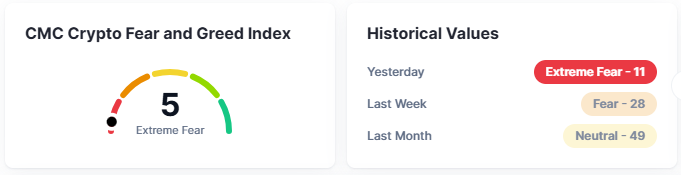
Weak trading volumes and sustained selling pressure encouraged many investors to exit positions despite technical indicators signaling oversold conditions. CoinMarketCap’s Crypto Fear and Greed Index fell even further from 11 to 5, indicating extreme fear among market participants.
Bitcoin’s recent performance contrasted sharply with that of gold. Despite the massive correction, gold is still up about 9% year-to-date while bitcoin has tanked almost 30% since January 1, 2026. This divergence challenged the narrative that positioned bitcoin as a reliable hedge against inflation or macroeconomic instability.
Public criticism intensified as market observers questioned long-standing bullish assumptions. Peter Schiff, cofounder of Echelon Wealth Partners, urged bitcoin holders to abandon what he described as a sinking ship. He also highlighted unrealized losses exceeding $4.6 billion at Strategy, whose aggressive bitcoin accumulation strategy now faces sustained price pressure.
ETF Outflows and Capitulation Signals
ETF outflows added to bitcoin’s downside as demand weakened. Market stress indicators reinforced this view. SoSoValue data show that US BTC Spot ETFs recorded $545 million in outflows on February 4, 2026, and $434 million on February 5, totalling $979 million across both days.
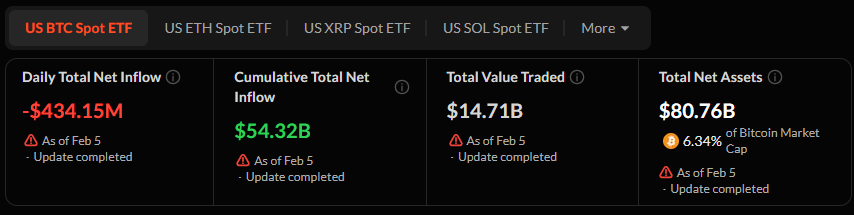
Bloomberg analyst Eric Balchunas also reports that BlackRock’s Bitcoin ETF $IBIT experienced its second-worst single-day drop since launch, after it saw a record $10B in daily trading volume as its price fell 13%.
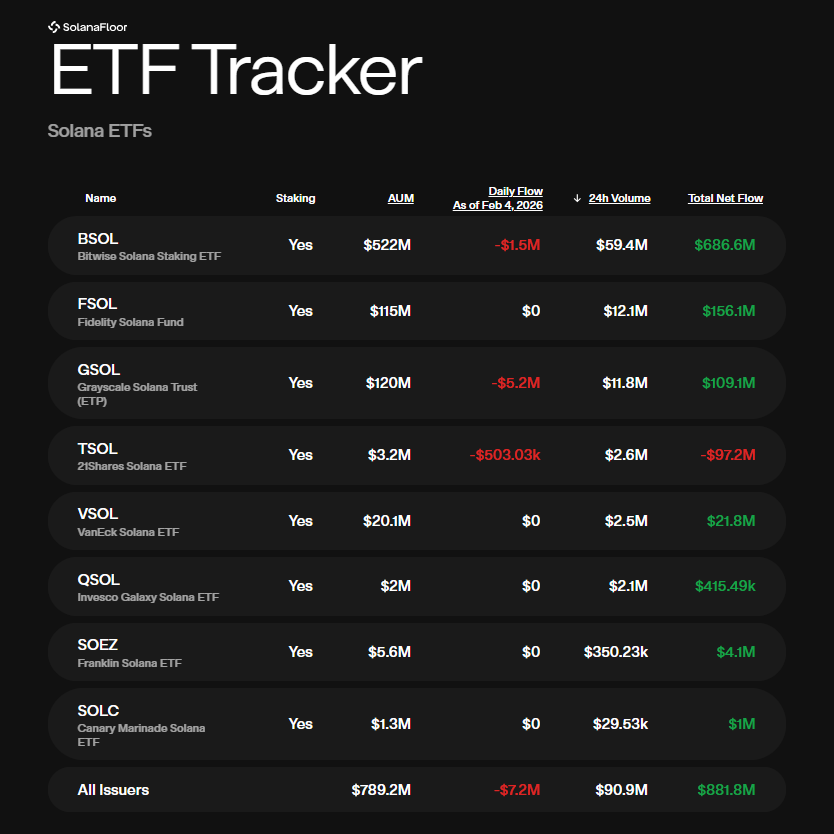
SolanaFloor’s ETF Tracker also reflects net outflows, with Solana ETFs experiencing $7.2 million in outflows on February 4.
Bitcoin also erased all gains from the post-election rally driven by optimism about pro-crypto policies, highlighting how quickly sentiment can reverse.
Despite the short-term turmoil, some institutions maintained a longer-term perspective. JPMorgan global markets strategist Nikolaos Panigirtzoglou argued that bitcoin is now more attractive than gold long term. The analyst noted that bitcoin now trades below its estimated production cost of $87,000 and that its volatility relative to gold has dropped to record lows. According to the analyst, this shift improved bitcoin’s risk-adjusted profile for investors willing to hold over a multi-year horizon, even as near-term conditions remain unstable.
Why the Sudden Drop?
Despite the speed and scale of the drawdown, no single catalyst has yet been identified as the definitive trigger for the market-wide sell-off. Unlike prior flash crashes, such as the October 10 event, when a Binance software issue was widely cited, there has been no confirmation of exchange outages, systemic trading errors, or operational failures contributing to the move.
Several theories have circulated among traders and analysts. One view points to cascading liquidations in highly leveraged crypto futures markets, where relatively modest spot declines can rapidly snowball as margin thresholds are breached.
Others have suggested that large, undisclosed sell orders from early holders or institutional desks may have exacerbated downside momentum during periods of thin liquidity.
At present, none of these explanations has been substantiated by official statements from major exchanges, regulators, or large market participants.
Silver Suffers One of Its Worst Sell-Offs
Silver delivered one of its most severe weekly declines in recent history. Spot silver prices dropped sharply again after a brief rebound, sliding nearly 30% to around $64 per ounce before recovering to its present price of $74. Analysts attributed the extreme volatility to speculative flows, leveraged positioning, and options-driven trading rather than a collapse in physical demand.
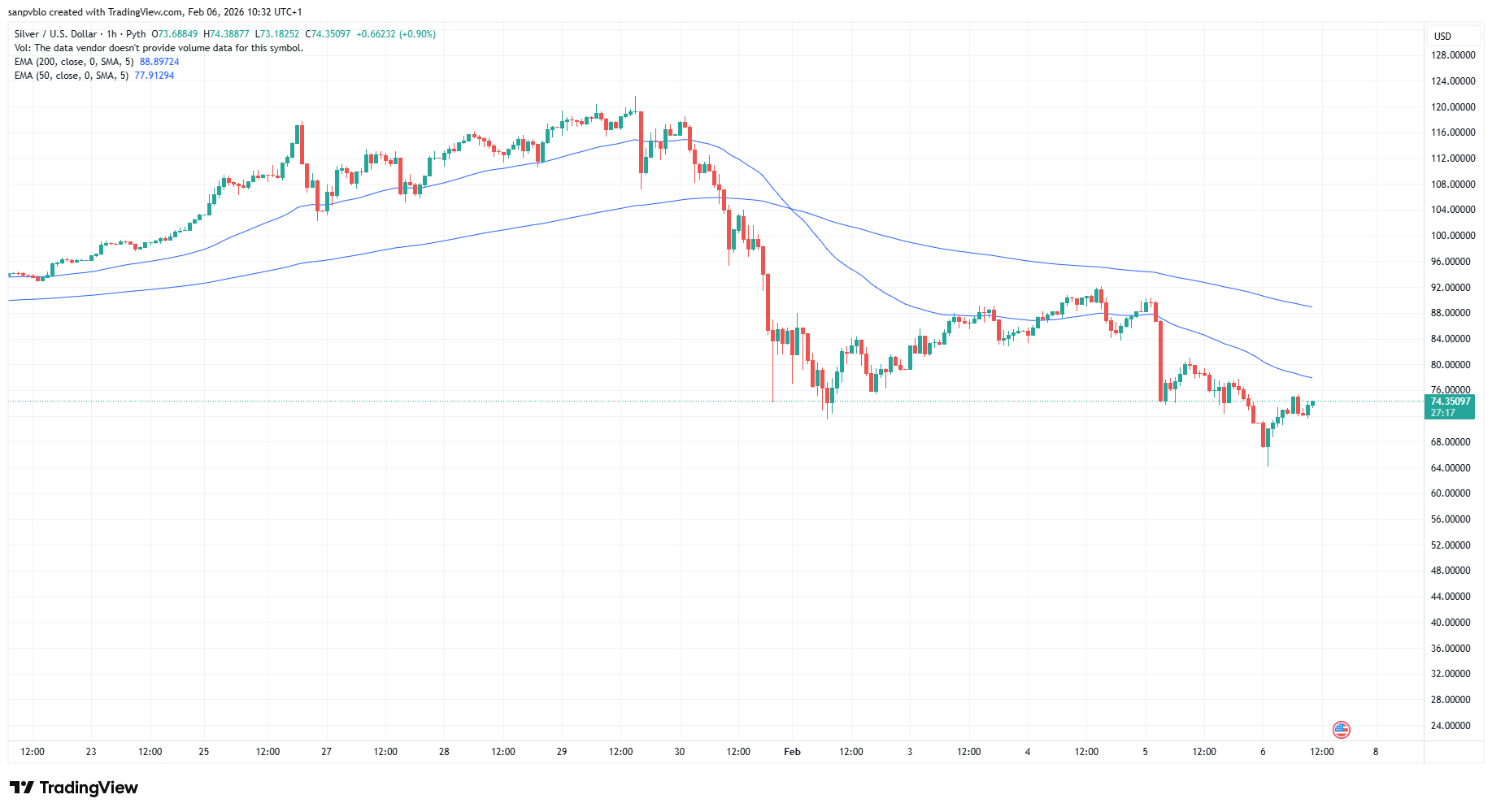
A stronger U.S. dollar and hawkish expectations around Federal Reserve leadership weighed heavily on precious metals. Significant ETF redemptions amplified selling pressure, while weaker Chinese manufacturing data raised concerns about industrial demand. Even so, futures markets remained in backwardation, suggesting tight physical supply despite falling paper prices.
U.S. Stocks Join the Broader Pullback
U.S. equities also retreated as investors reduced risk exposure. Technology stocks led the decline, with the Nasdaq Composite posting its worst week since November. Shares of Alphabet dropped sharply after the company outlined plans to significantly increase capital spending, reviving concerns about the profitability of large-scale AI investments.
The Dow Jones Industrial Average fell nearly 600 points at one stage, while the S&P 500 and Nasdaq both recorded losses exceeding 1%. Weak labor market data added to investor anxiety, as January layoffs surged to levels not seen since 2009. Treasury yields declined as investors moved toward safer assets, reinforcing the broader defensive shift.
Read More on SolanaFloor
Moving Forward? - Kyle Samani Steps Back From Multicoin, Transitions to Advisory Role
Prop AMM BisonFi Continues to Lead Solana Weekly DEX Trading Volume
Bitwise CIO Matt Hougan on The Big Picture